
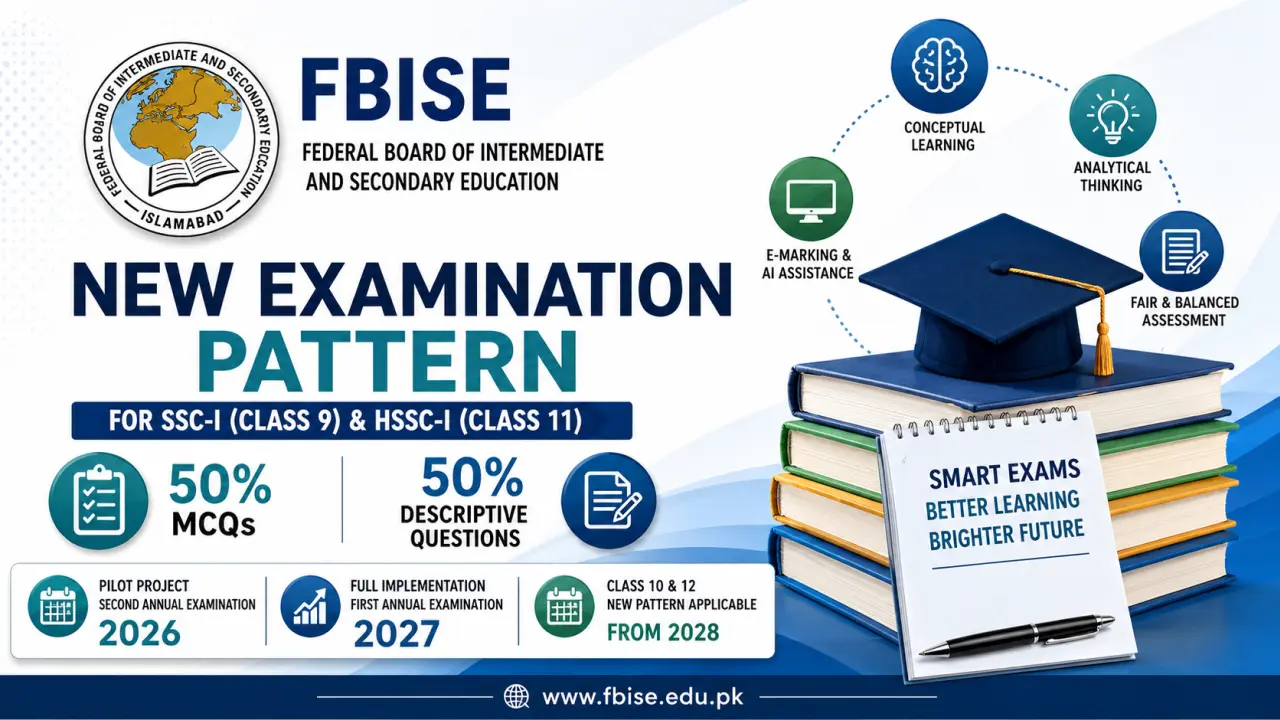
The Federal Board of Intermediate and Secondary Education (FBISE) has announced a major change in its examination system. During the 70th E-Kachehri, FBISE introduced a new examination pattern that aims to improve students’ learning, critical thinking, and conceptual understanding.
The new pattern will first be introduced as a pilot project in the Second Annual Examination 2026 for Class 9 (SSC-I) and Class 11 (HSSC-I). After reviewing the results of the pilot project, the board will implement the new examination system completely in the First Annual Examination 2027 for these classes.
This article explains everything students, teachers, and parents need to know about the new FBISE paper pattern.
Why Has FBISE Introduced a New Examination Pattern 2026?
Education is changing around the world. Modern education systems focus on understanding concepts instead of memorizing answers. FBISE has also taken this step to make examinations more meaningful and student-friendly.

The new examination pattern will encourage students to:
- Understand concepts deeply.
- Improve critical thinking skills.
- Develop analytical abilities.
- Reduce dependence on rote learning.
- Prepare for higher education and competitive examinations.
The board believes that this system will help students become better learners and problem solvers.
New Paper Pattern of FBISE 2026
The biggest change in the new examination system is the division of marks.

50% Multiple Choice Questions (MCQs)
Half of the examination paper will consist of objective-type questions.
These questions will test:

- Basic concepts
- Understanding of topics
- Application of knowledge
- Analytical thinking
- Problem-solving skills
Students should not expect only simple memory-based MCQs. Many questions may require careful thinking before selecting the correct answer.
50% Descriptive (Subjective) Questions
The remaining half of the paper will include descriptive questions.
These questions may include:
- Short answer questions
- Long answer questions
- Numerical problems
- Diagram-based questions
- Explanation of concepts
- Reasoning and analytical questions
Students will need to explain their answers clearly and logically instead of writing memorized paragraphs.
Pilot Project in Second Annual Examination 2026
The new examination pattern will first be tested in the Second Annual Examination 2026.
This pilot project will only be conducted for:
- SSC-I (Class 9)
- HSSC-I (Class 11)
The purpose of the pilot project is to evaluate the effectiveness of the new system before implementing it across the board.
Subjects Included in the Pilot Project
The new paper pattern will initially be introduced in only five science subjects:
- Mathematics
- Physics
- Chemistry
- Biology
- Computer Science
Other subjects will continue under the existing examination pattern until further announcements by FBISE.
Full Implementation in First Annual Examination 2027
After the successful completion of the pilot project, FBISE will fully implement the new examination pattern in the First Annual Examination 2027.
This implementation will apply to:
- SSC-I (Class 9)
- HSSC-I (Class 11)
Students appearing in these classes should prepare according to the new paper format.
What About Class 10 and Class 12?
Many students are asking whether the new paper pattern will also apply to Class 10 (SSC-II) and Class 12 (HSSC-II).
The answer is No.
According to FBISE:
- Class 10 and Class 12 students are exempt during 2027.
- They will continue with the current examination system in 2027.
- The new examination pattern will apply to Class 10 and Class 12 from 2028.
This gives students and teachers enough time to prepare for the new system.
E-Marking and the Role of Artificial Intelligence (AI)
Another important announcement made during the 70th E-Kachehri was the introduction of E-Marking with the assistance of Artificial Intelligence (AI).
Many students misunderstood this announcement and believed AI would check papers independently. FBISE has clearly explained that this is not the case.
How Will AI Help?
AI will only assist human examiners.
Its role includes:
- Providing academic input.
- Supporting critical analysis.
- Helping examiners during the evaluation process.
- Improving consistency and efficiency in marking.
AI is simply a supporting tool and not a replacement for teachers or examiners.
Final Decision Will Always Be Made by Human Examiners
FBISE has clearly stated that:
- Human examiners will make the final marking decisions.
- AI will not award marks.
- AI cannot replace experienced examiners.
- Human supervision will remain an essential part of the examination system.
This means students can be confident that their answer sheets will still be assessed by qualified human examiners.
How Should Students Prepare?
Students should start preparing according to the new examination pattern.
Some useful preparation tips include:
- Focus on understanding concepts instead of memorizing notes.
- Practice both MCQs and descriptive questions regularly.
- Solve numerical and application-based questions.
- Read the textbook carefully.
- Improve writing skills for descriptive answers.
- Attempt past papers and model papers.
- Revise important formulas, definitions, and diagrams.
- Practice time management during mock tests.
Regular study and conceptual learning will help students perform better under the new system.
Benefits of the New Examination Pattern
The new system offers several advantages:
- Better conceptual learning.
- Reduced rote memorization.
- Improved analytical thinking.
- Stronger problem-solving skills.
- Fair and balanced assessment.
- Better preparation for university studies.
- Improved transparency through E-Marking.
- Support from AI while keeping human supervision.
Overall, the new examination pattern is expected to improve the quality of education and assessment.
Important Timeline
| Examination | Classes | Status |
|---|---|---|
| Second Annual Examination 2026 | Class 9 & Class 11 | Pilot Project |
| First Annual Examination 2027 | Class 9 & Class 11 | Full Implementation |
| First Annual Examination 2027 | Class 10 & Class 12 | Exempt |
| From 2028 | Class 10 & Class 12 | New Pattern Applicable |
Conclusion
The New Examination Pattern of FBISE is an important step toward modernizing the education system in Pakistan. By introducing 50% MCQs and 50% descriptive questions, the Federal Board aims to promote conceptual understanding, analytical thinking, and better learning outcomes.
The pilot project will begin in the Second Annual Examination 2026 for SSC-I (Class 9) and HSSC-I (Class 11) in five science subjects: Mathematics, Physics, Chemistry, Biology, and Computer Science. The system will be fully implemented for these classes in the First Annual Examination 2027, while Class 10 and Class 12 will adopt the new pattern from 2028.
Students should begin preparing now by focusing on concepts, practicing both objective and subjective questions, and improving their analytical skills. With AI assisting in E-Marking and human examiners making the final decisions, the new system aims to provide a fair, transparent, and high-quality assessment process.
Frequently Asked Questions (FAQs)
1. What is the new FBISE examination pattern?
The new FBISE examination pattern divides the paper into 50% MCQs and 50% descriptive questions.
2. Which classes will follow the new pattern first?
The new pattern will first be introduced for SSC-I (Class 9) and HSSC-I (Class 11).
3. When will the pilot project start?
The pilot project will begin in the Second Annual Examination 2026.
4. When will the new pattern be fully implemented?
It will be fully implemented for Class 9 and Class 11 in the First Annual Examination 2027.
5. Which subjects are included in the pilot project?
The pilot project covers Mathematics, Physics, Chemistry, Biology, and Computer Science.
6. Will Class 10 and Class 12 follow the new pattern in 2027?
No. They are exempt in 2027 and will continue with the existing examination system.
7. When will Class 10 and Class 12 adopt the new pattern?
The new examination pattern will apply to Class 10 and Class 12 from 2028.
8. Will AI check examination papers?
No. AI will only assist the evaluation process by providing academic input and critical analysis.
9. Who will award the final marks?
Qualified human examiners will award the final marks. AI will not make the final marking decisions.
10. Where can students get official FBISE updates?
Students should always visit the official FBISE website at www.fbise.edu.pk for the latest announcements.