For decades, admission to Pakistan’s top universities such as NUST, LUMS, GCU Lahore, Punjab University, COMSATS, UET Lahore, FAST-NUCES, PIEAS, and GIKI has been considered a dream for thousands of students. These institutions have produced engineers, doctors, scientists, entrepreneurs, civil servants, and business leaders who have contributed to Pakistan’s development.
However, in recent admission cycles, many universities have reported lower application numbers or lower closing merit in several programs, especially in public universities. Education experts believe this is a warning sign that deserves immediate attention. A decline in university admissions does not necessarily mean students are less capable; instead, it reflects changing economic conditions, career priorities, and weaknesses in Pakistan’s higher education system. Reports from Punjab have highlighted a significant fall in admissions at several public universities, linking it to financial hardship, outdated curricula, and poor employment prospects.
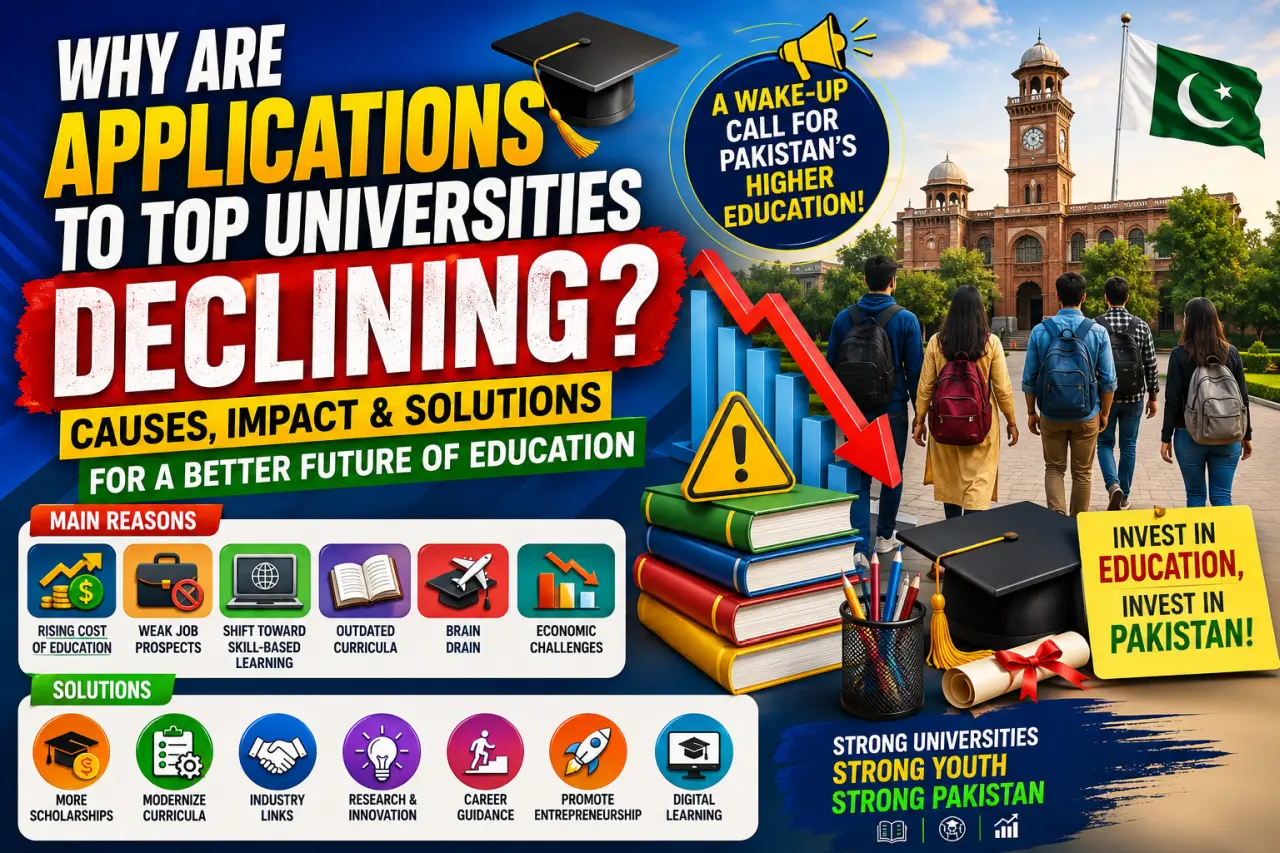
Why Are University Applications Declining?
1. Rising Cost of Higher Education
One of the biggest reasons is the increasing cost of university education.
Over the last few years:

- Tuition fees have increased.
- Hostel charges have risen.
- Transportation and accommodation costs have become expensive.
- Books, laptops, and internet expenses have also increased.
Many middle-class families now struggle to finance a four-year degree. As a result, some students delay university, choose shorter diploma programs, or enter the workforce immediately after Intermediate.
2. Weak Employment Opportunities After Graduation
A university degree no longer guarantees a good job.
Many graduates face:

- Long periods of unemployment
- Low starting salaries
- Jobs unrelated to their degrees
- Fierce competition for limited vacancies
Students increasingly question whether investing four years and substantial money in a degree will provide a reasonable return.
3. Shift Toward Skill-Based Learning
Young people are increasingly choosing practical skills over traditional degrees.

Popular alternatives include:
- Artificial Intelligence
- Data Science
- Digital Marketing
- Graphic Design
- Cybersecurity
- Web Development
- Video Editing
- Freelancing
- E-commerce
These skills can often be learned through online platforms within months and may generate income much sooner than a traditional degree.
4. Outdated University Curricula
Many university programs still emphasize theory rather than practical experience.
Students expect:
- Modern laboratories
- Industry projects
- AI and emerging technology courses
- Internships
- Entrepreneurship training
When curricula fail to keep pace with technological change, graduates become less competitive in the job market.
5. Brain Drain
Thousands of talented Pakistani students now seek higher education abroad.
Countries such as:
- China
- Türkiye
- Malaysia
- Australia
- Canada
- Germany
offer scholarships, stronger research environments, and better career opportunities, encouraging many high-performing students to leave Pakistan after Intermediate.
6. Declining Purchasing Power
Pakistan’s economic challenges have reduced household purchasing power.
Families increasingly prioritize:
- Essential living expenses
- Healthcare
- Utility bills
- Food
Higher education often becomes a financial burden rather than an affordable investment.
7. Population Growth Is Not Translating into University Enrollment
Pakistan has a young population, but access to higher education remains limited.
According to analysis based on the 2023 census, only about 9.4% of Pakistan’s population holds a bachelor’s degree or higher, highlighting that higher education participation remains relatively low despite demographic growth.
8. Competition from Online Education
Students now have access to internationally recognized online courses from global institutions.
Many learners prefer:
- Professional certifications
- Remote learning
- Flexible schedules
- Lower costs
instead of enrolling in full-time university programs.
Impact on Pakistan
If this trend continues, Pakistan could face several long-term challenges.
Reduced Research Capacity
Universities are the main centers of scientific research. Fewer students may lead to fewer researchers and reduced innovation.
Shortage of Skilled Professionals
Pakistan may face shortages of:
- Engineers
- Scientists
- Teachers
- Economists
- Researchers
- IT professionals
Slower Economic Growth
A highly educated workforce is essential for productivity, industrial development, and technological advancement.
Increased Brain Drain
If students lose confidence in local universities, more talented individuals may seek education and employment abroad.
How Can Pakistan Reverse This Trend?
1. Expand Scholarships and Financial Aid
The government and universities should increase:
- Need-based scholarships
- Merit scholarships
- Interest-free student loans
to ensure deserving students are not excluded because of financial constraints.
2. Update University Curricula
Universities should integrate:
- Artificial Intelligence
- Machine Learning
- Robotics
- Data Science
- Cloud Computing
- Entrepreneurship
- Green technologies
into degree programs so graduates are prepared for modern careers.
3. Strengthen University–Industry Links
Every degree program should include:
- Paid internships
- Industry projects
- Career counseling
- Employer partnerships
This would improve graduate employability.
4. Promote Research and Innovation
Government investment in research should increase through:
- Better laboratories
- Research grants
- Innovation centers
- Startup incubators
5. Improve Career Guidance
Many students select degrees without understanding future career prospects.
Schools and colleges should provide professional career counseling before university admissions.
6. Encourage Entrepreneurship
Universities should help students build businesses by offering:
- Startup incubation
- Business mentoring
- Innovation competitions
- Access to seed funding
Graduates who create businesses can also generate employment for others.
7. Enhance Digital Learning
Universities should expand:
- Hybrid learning
- Online degree options
- Digital libraries
- Virtual laboratories
to make education more accessible.
What Should Students Do?
Students should choose a degree based on:
- Personal interests
- Future demand
- Practical skills
- Industry relevance
- Internship opportunities
Rather than following trends, they should research career outcomes and continuously develop technical and soft skills alongside their academic studies.
Conclusion
The decline in applications to Pakistan’s leading universities is a serious issue that reflects broader economic and educational challenges rather than a lack of student ability. Rising education costs, uncertain employment prospects, outdated curricula, and the growing appeal of skill-based and online learning are reshaping student choices.
This trend can be reversed if policymakers, universities, industries, and society work together. By modernizing curricula, expanding financial support, strengthening links with employers, investing in research, and promoting innovation, Pakistan can rebuild confidence in higher education.
A strong university system is essential for producing the scientists, engineers, entrepreneurs, teachers, and leaders who will shape Pakistan’s future. Investing in quality higher education today is an investment in the country’s economic growth, technological advancement, and global competitiveness.