
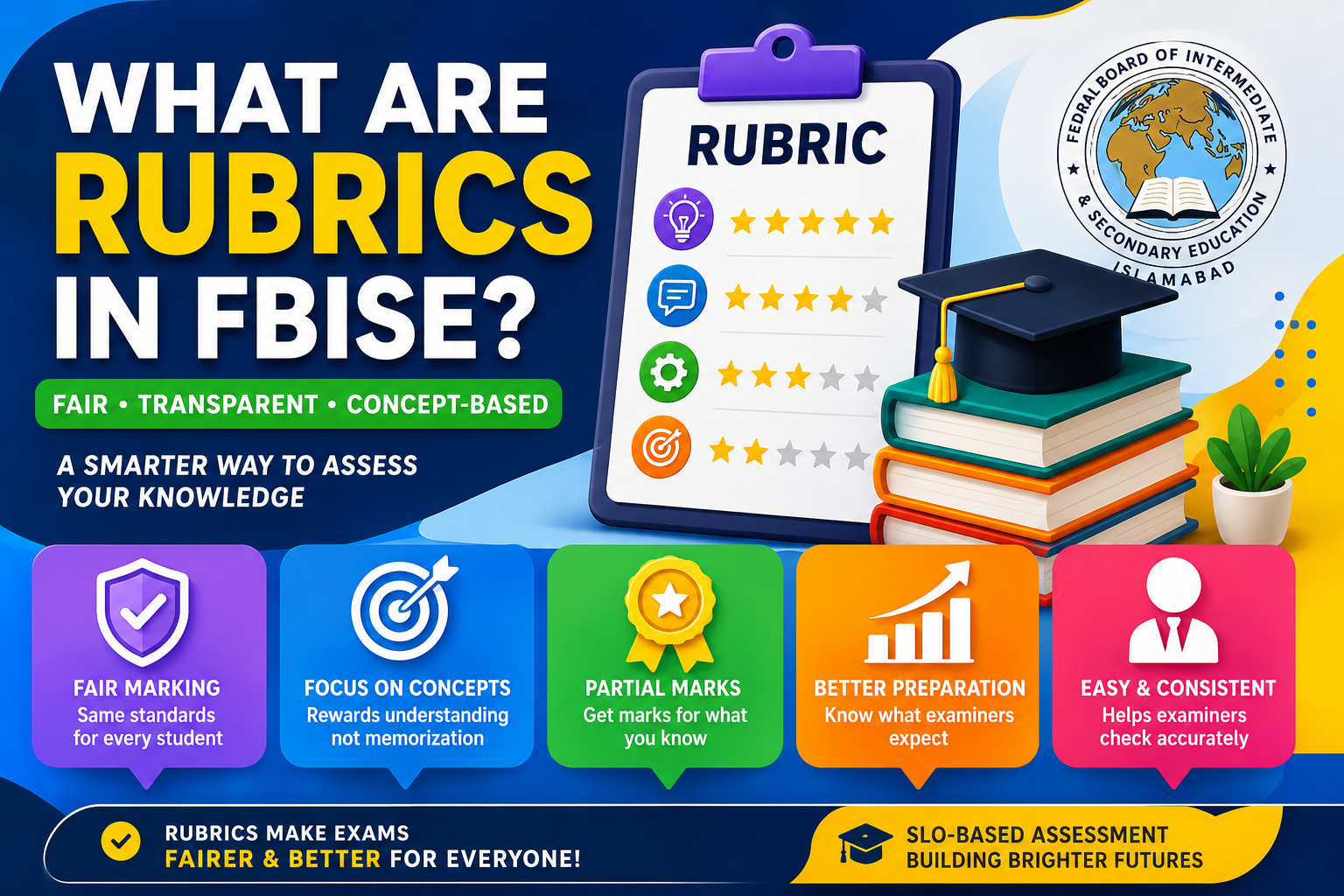
The Federal Board of Intermediate and Secondary Education (FBISE) has transformed its examination system by introducing Student Learning Outcomes (SLO)-based assessment. One of the most important tools used in this modern assessment system is the rubric.
Many SSC and HSSC students hear about rubrics after examinations, but very few understand what they actually are or how they influence paper checking. In simple words, a rubric is a standardized marking guide that tells examiners exactly how to award marks for every descriptive question. Instead of relying on personal judgment, examiners assess answers according to predefined criteria prepared by FBISE.
According to the official FBISE Assessment and Evaluation Training Manual, rubrics improve fairness, transparency, and consistency in paper marking while encouraging conceptual learning instead of rote memorization.
If you are preparing for FBISE board examinations, understanding rubrics can help you write better answers and score higher marks.

What Is a Rubric?
A rubric is a scoring guide that explains how marks should be awarded for each question. It clearly describes what an examiner should look for in a student’s answer.
Every FBISE rubric consists of three major components:
1. Criteria
Criteria are the learning outcomes or qualities that students are expected to demonstrate. These may include:

- Understanding of concepts
- Correct explanation
- Logical reasoning
- Application of knowledge
- Proper use of scientific terms
- Accurate calculations
- Correct diagrams where required
2. Performance Standards
Performance standards divide student responses into different achievement levels such as excellent, satisfactory, developing, or incomplete.
3. Performance Descriptors
These explain exactly what a student must write to earn marks at each performance level. Performance descriptors remove confusion and ensure all examiners follow the same marking standard.

Why Did FBISE Introduce Rubrics?
In the traditional examination system, different examiners could award different marks for the same answer because marking often depended on individual judgment.
To solve this issue, FBISE introduced rubrics to:
- Standardize paper checking across Pakistan.
- Ensure fairness for every student.
- Improve transparency in marking.
- Reduce examiner bias.
- Encourage conceptual understanding.
- Support SLO-based assessment.
- Award marks according to learning outcomes instead of memorized textbook wording.
This system makes the evaluation process more reliable and trustworthy.
How Do Rubrics Work During Paper Checking?
After board examinations are completed, FBISE provides official rubrics to all examiners before marking begins.
The rubric specifies:
- Important points expected in each answer.
- Distribution of marks.
- Keywords and concepts that must be included.
- Rules for awarding partial marks.
- Acceptable alternative answers.
For example, if a question carries 4 marks, the rubric may divide the marks according to four correct points. A student who writes three correct points may receive 3 marks, while another student with two correct points receives 2 marks. This ensures that students receive credit for what they know instead of losing all marks due to one missing point.
Advantages of Rubrics for Students
1. Fair and Transparent Marking
Every student’s paper is checked using the same marking criteria, ensuring equal treatment.
2. Partial Marks
Students receive marks for correct portions of their answers, even if the entire answer is not perfect.
3. Better Understanding of Exam Expectations
Rubrics help students understand what examiners expect in high-scoring answers.
4. Improved Answer Writing
Students learn to organize their answers logically and include all important points.
5. Focus on Conceptual Learning
Instead of memorizing textbook paragraphs, students are encouraged to understand concepts and apply their knowledge.
6. Better Preparation for Board Exams
Practicing according to rubrics helps students identify weak areas and improve before examinations.
Advantages of Rubrics for Examiners
Rubrics also make the examiner’s job easier and more accurate.
Faster Paper Checking
Examiners can evaluate answers more efficiently because the marking criteria are already defined.
Uniform Assessment
Thousands of papers are checked using the same standard across all examination centers.
Reduced Personal Bias
Rubrics minimize subjective judgment and improve fairness.
Better Accuracy
Important points cannot be overlooked because the rubric clearly identifies every marking criterion.
Improved Quality Control
Chief examiners can easily monitor whether paper checking follows official FBISE guidelines.
How Rubrics Support SLO-Based Assessment
FBISE examinations now focus on Student Learning Outcomes (SLOs) rather than rote memorization.
Rubrics assess whether students can:
- Understand concepts.
- Apply knowledge in new situations.
- Analyze information.
- Solve problems logically.
- Explain scientific principles.
- Draw conclusions.
- Use correct terminology.
- Present answers clearly.
This approach prepares students with practical knowledge instead of simply memorizing textbook content.
Tips for Students to Score Better Using Rubrics
Students preparing for FBISE examinations should:
- Study SLOs carefully.
- Practice conceptual questions regularly.
- Focus on understanding instead of memorization.
- Write answers in points where appropriate.
- Include diagrams whenever required.
- Use correct scientific terms and formulas.
- Attempt previous model papers.
- Review FBISE sample rubrics if available.
Following these strategies can significantly improve examination performance.
Why Every FBISE Student Should Understand Rubrics
Rubrics are not just a marking guide for examiners—they are also an effective learning tool for students. By understanding how marks are awarded, students can prepare smarter, write more organized answers, and avoid unnecessary mistakes.
As FBISE continues to modernize its examination system, rubrics have become an essential part of fair assessment. They ensure that every student is evaluated on knowledge, understanding, and application rather than memorization alone.
Whether you are appearing in SSC or HSSC examinations, learning how rubrics work can give you a clear advantage and help you achieve better results.
Frequently Asked Questions (FAQs)
1. What are rubrics in FBISE?
Rubrics are official marking guides prepared by FBISE that explain how examiners should award marks for descriptive questions based on predefined criteria and performance standards.
2. Why are rubrics important for students?
Rubrics help students understand what examiners expect in an answer, improve answer-writing skills, and increase their chances of scoring higher marks through conceptual learning.
3. Do rubrics allow partial marks?
Yes. FBISE rubrics allow examiners to award partial marks when a student provides some correct information even if the complete answer is not perfect.
4. Are rubrics used in all FBISE subjects?
Yes. Rubrics are prepared for descriptive questions in different FBISE subjects, although the criteria vary according to the subject and question type.
5. How can students prepare according to FBISE rubrics?
Students should focus on Student Learning Outcomes (SLOs), practice conceptual questions, study model papers, write answers in a structured way, and understand the marking criteria used by FBISE.