
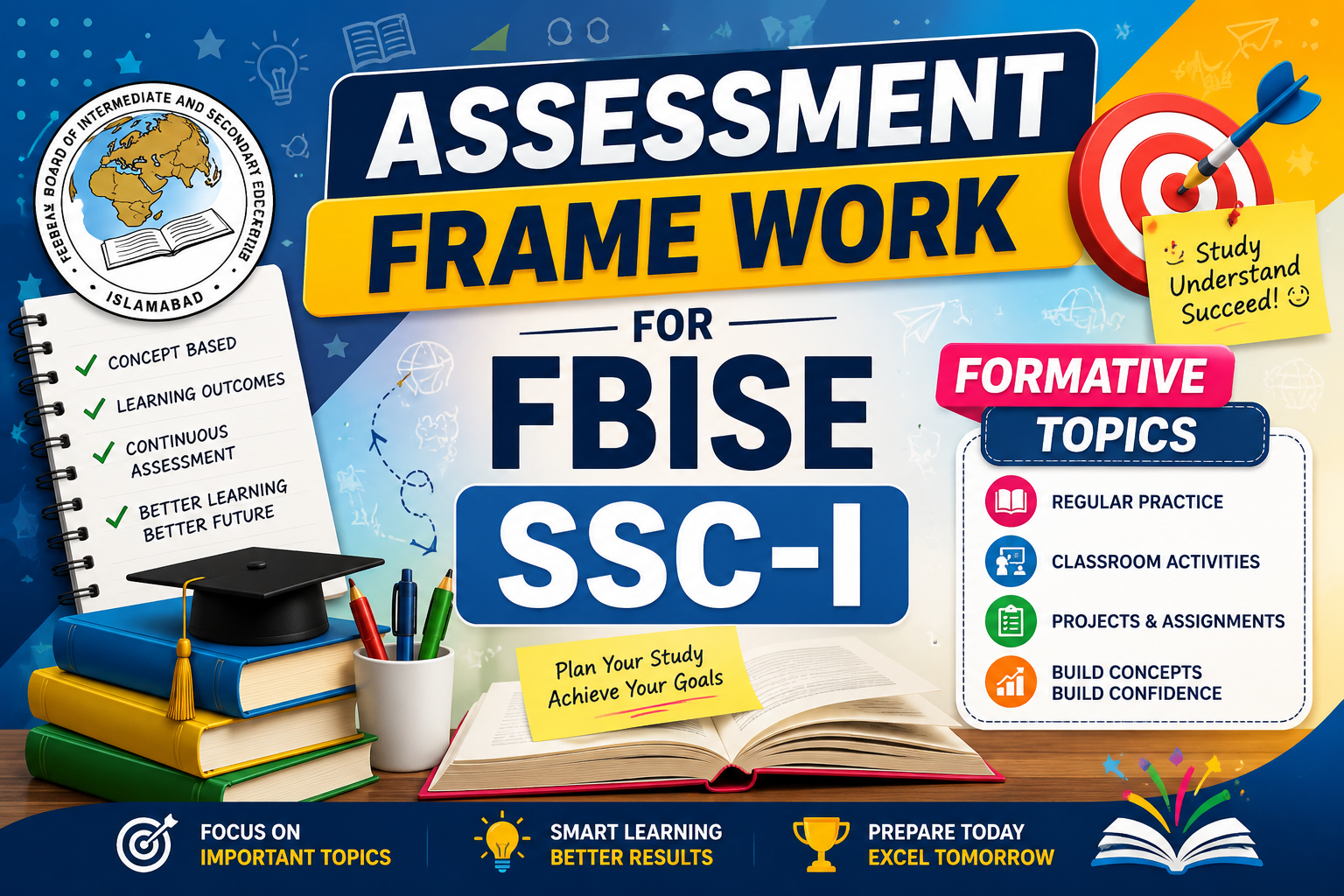
The education system is changing rapidly to improve students’ understanding, critical thinking, and practical skills. One of the most important improvements introduced in recent years is the Assessment Framework for SSC-I (Class 9). This framework helps students, teachers, parents, and examiners understand exactly what should be taught, learned, and assessed during the academic year.
Instead of focusing only on memorization, the Assessment Framework encourages conceptual learning and the application of knowledge in real-life situations. It clearly divides the syllabus into Formative Topics and Summative Topics, making exam preparation more organized and effective.
In this article, you will learn everything about the SSC-I Assessment Framework, the difference between formative and summative topics, their importance, and how students can use them to achieve better examination results.
What is an Assessment Framework?
An Assessment Framework is a structured document prepared according to the national curriculum. It outlines:

- Learning outcomes
- Student competencies
- Assessment methods
- Important topics
- Skills to be evaluated
- Distribution of syllabus for different assessments
Its main purpose is to ensure that students are evaluated fairly and consistently while encouraging meaningful learning instead of rote memorization.
What are Formative Topics?
Formative Topics are those parts of the syllabus that are assessed during the learning process. These topics help teachers monitor students’ progress throughout the academic session.
Formative assessment is continuous and focuses on improving learning rather than assigning final grades.

Examples of formative assessments include:
- Classroom quizzes
- Oral questioning
- Assignments
- Homework
- Practical activities
- Class discussions
- Presentations
- Group work
- Projects
- Short tests
The purpose is to identify students’ strengths and weaknesses before the final examination.
Importance of Formative Topics
Formative topics play a vital role in students’ academic success because they:
Improve Conceptual Understanding
Students understand concepts gradually instead of memorizing them before examinations.
Identify Learning Gaps
Teachers can easily identify which concepts students have not understood and provide additional support.
Reduce Examination Pressure
Since students learn throughout the year, they feel less stressed during final examinations.
Encourage Active Participation
Students become more involved in classroom activities and discussions.
Build Confidence
Regular practice improves confidence and prepares students for larger assessments.
Promote Critical Thinking
Many formative activities encourage students to analyze, evaluate, and solve problems rather than simply recalling information.
What are Summative Topics?
Summative Topics are assessed at the end of a learning period. These topics are included in final examinations and determine students’ overall academic achievement.
Summative assessment measures how well students have mastered the required knowledge and skills after completing the prescribed syllabus.
Examples include:
- Annual examinations
- Final term examinations
- Board examinations
- Practical examinations
- End-of-unit assessments
These assessments contribute significantly to students’ final grades.
Importance of Summative Topics
Summative topics are equally important because they:
Measure Overall Learning
They evaluate how much students have learned during the academic year.
Maintain Educational Standards
Board examinations ensure that students across different schools are assessed using the same criteria.
Prepare Students for Higher Education
Summative assessments help students develop examination skills required for future academic studies.
Encourage Complete Syllabus Preparation
Students study the entire syllabus systematically.
Support Academic Decision-Making
Final examination results help educational institutions evaluate students’ readiness for the next class.
Difference Between Formative and Summative Topics
| Formative Assessment | Summative Assessment |
|---|---|
| Conducted during learning | Conducted after learning |
| Focuses on improvement | Focuses on final achievement |
| Regular feedback | Final grades |
| Low-stakes assessment | High-stakes assessment |
| Helps identify weaknesses | Measures overall performance |
| Continuous process | End-of-term evaluation |
Both types of assessment complement each other and contribute to quality education.
Why is the Assessment Framework Important for SSC-I Students?
The SSC-I Assessment Framework helps students:
- Understand what they are expected to learn.
- Focus on important learning outcomes.
- Prepare according to board expectations.
- Develop conceptual understanding.
- Improve examination performance.
- Manage study time effectively.
- Avoid unnecessary topics.
- Practice according to assessment requirements.
Students who follow the Assessment Framework generally prepare more confidently because they know the purpose behind each topic.
How Should Students Use the Assessment Framework?
Students should use the Assessment Framework in the following ways:
Study Formative Topics First
Master the concepts through classroom learning, homework, and practice.
Revise Summative Topics Regularly
Prepare these topics thoroughly for annual examinations.
Understand Learning Outcomes
Rather than memorizing, understand what each topic expects you to learn.
Practice Higher-Order Questions
The new examination pattern emphasizes conceptual and analytical questions.
Keep Track of Progress
Regularly review completed topics and identify areas needing improvement.
Students Can Check Formative Topics of SSC-I Subjects Here
Students preparing for SSC-I (Class 9) can easily check and note the formative topics of every subject from this website. These topic lists are organized according to the official Assessment Framework and are designed to help students prepare more effectively throughout the academic year.
By reviewing the formative topics for each subject, students can:
- Prepare classroom assessments with confidence.
- Focus on important learning outcomes.
- Improve conceptual understanding.
- Plan their studies more efficiently.
- Avoid missing important topics.
- Track their academic progress throughout the year.
Students are encouraged to carefully note the formative topics of each SSC-I subject from here and use them as a study checklist during the session.
Benefits for Teachers
The Assessment Framework also benefits teachers by helping them:
- Plan lessons effectively.
- Design classroom assessments.
- Prepare quality question papers.
- Monitor student progress.
- Provide timely feedback.
- Improve teaching strategies.
- Align classroom instruction with curriculum objectives.
Benefits for Parents
Parents can also use the Assessment Framework to:
- Understand their child’s learning goals.
- Monitor academic progress.
- Support homework and revision.
- Encourage continuous learning instead of last-minute preparation.
- Communicate effectively with teachers.
Tips for SSC-I Students
To make the best use of the Assessment Framework:
- Read the framework before starting each chapter.
- Highlight formative topics.
- Prepare notes for every learning outcome.
- Solve conceptual questions regularly.
- Practice diagrams and numerical problems where applicable.
- Revise important topics every week.
- Discuss difficult concepts with teachers.
- Attempt sample papers before examinations.
Conclusion
The SSC-I Assessment Framework is much more than a syllabus guide—it is a roadmap for effective learning and successful examination preparation. By clearly distinguishing between Formative Topics and Summative Topics, it helps students develop strong concepts, improve classroom performance, and excel in board examinations.
Students should make full use of the Assessment Framework throughout the academic year rather than waiting until the final examination. Regular study of formative topics, combined with systematic preparation of summative topics, leads to better understanding, higher confidence, and improved academic results.
Students can check and note the formative topics of every SSC-I subject from this website and use them as a practical study guide throughout the academic session.
Frequently Asked Questions (FAQs)
1. What is the SSC-I Assessment Framework?
It is a guideline that explains the learning outcomes, important topics, and assessment methods for Class 9 students.
2. What are formative topics?
Formative topics are assessed during classroom learning through quizzes, assignments, projects, presentations, and other continuous assessments.
3. What are summative topics?
Summative topics are evaluated in final examinations, including annual and board exams, to measure students’ overall learning.
4. Why should students follow the Assessment Framework?
It helps students prepare according to curriculum objectives, improve conceptual understanding, and perform better in examinations.
5. Where can students find the formative topics for SSC-I subjects?
Students can check and note the formative topics of each SSC-I subject from this website, where they are organized according to the official Assessment Framework for easy study and revision.