
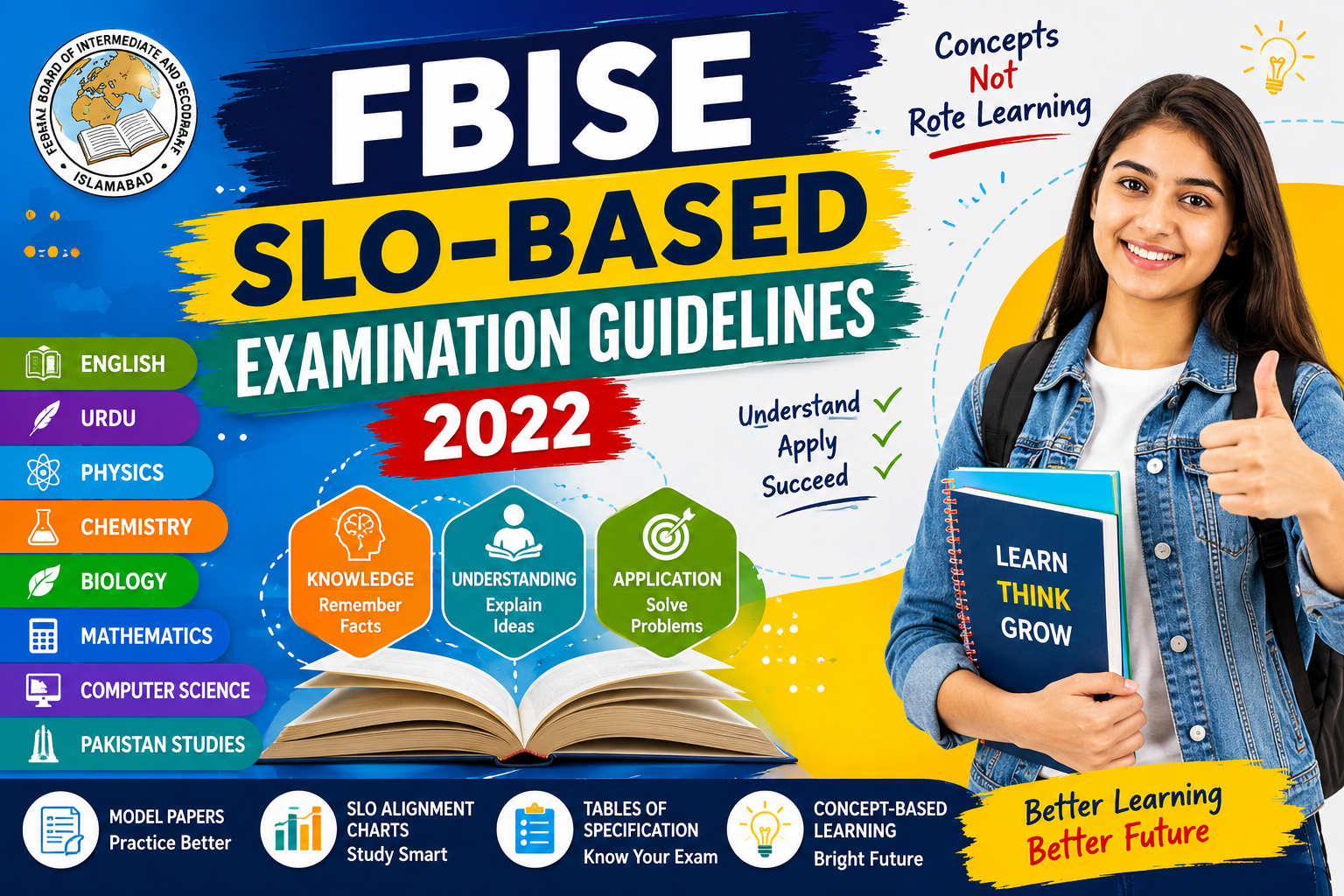
The Federal Board of Intermediate and Secondary Education (FBISE), Islamabad, introduced a major change in Pakistan’s education system by implementing the Student Learning Outcomes (SLO)-Based Examination System. This reform was officially introduced through the Guidelines for SLO-Based Examinations, issued on 25 August 2022.
The purpose of this new examination system is to replace the old method of rote learning with a modern assessment system that encourages students to understand concepts, think critically, and solve problems instead of simply memorizing textbook content.
If you are a student preparing for FBISE examinations, a teacher planning classroom instruction, or a parent supporting your child’s education, understanding these guidelines is extremely important.
In this article, we explain everything in easy English.

Why Did FBISE Introduce the SLO-Based Examination System?
For many years, examinations mainly tested how well students could memorize their textbooks. Students often focused on remembering long questions and answers without fully understanding the concepts.
To improve the quality of education, FBISE decided to shift from:
- Memorization-based learning
- Traditional examination methods
towards:

- Concept-based learning
- Critical thinking
- Practical understanding
- Problem-solving skills
- Real-life application of knowledge
According to FBISE, the new assessment system is designed to encourage students to learn, understand, analyze, and apply concepts instead of simply recalling information from memory.
When Was the SLO-Based Examination System Implemented?
The Federal Board officially implemented the SLO-Based Examination Policy in the SSC and HSSC Annual Examinations 2022.

The policy was successfully introduced for eight major subjects, making it one of the biggest educational reforms in recent years.
Subjects Included in SLO-Based Examinations
Initially, FBISE introduced SLO-based examinations in the following eight core subjects:
- English (Compulsory)
- Urdu (Compulsory)
- Physics
- Chemistry
- Biology
- Computer Science
- Mathematics
- Pakistan Studies
These subjects now follow the Student Learning Outcomes (SLOs), ensuring that examination questions assess understanding rather than memorization.
How Did FBISE Help Students and Teachers?
Before implementing the new examination system, FBISE provided several resources to help schools, teachers, and students understand the new assessment method.
These resources included:
1. Model Question Papers
FBISE prepared three sets of model question papers for every subject.
These papers were released quarterly and showed students the new style of examination questions.
2. SLO Alignment Charts
Each model paper was accompanied by an SLO Alignment Chart.
These charts explain which Student Learning Outcomes are being assessed by each question, helping teachers plan lessons and students understand what they need to learn.
3. Tables of Specification (TOS)
One of the most useful resources introduced by FBISE is the Table of Specification (TOS).
The TOS explains:
- which SLOs are included in the examination,
- how many questions come from each chapter,
- the percentage of different cognitive levels,
- the overall distribution of marks.
This helps teachers prepare balanced assessments and allows students to focus on important learning outcomes instead of guessing exam questions.
4. Solutions of Model Papers
To make learning easier, FBISE also published complete solutions for all model question papers.
Students can use these solved papers to understand:
- the expected answer format,
- marking criteria,
- question style,
- conceptual approach.
Where Can Students Access These Resources?
According to the official guidelines, all these learning resources—including model papers, SLO alignment charts, tables of specification, and solved papers—were made available on the official FBISE website for the guidance of students, teachers, school heads, and other stakeholders.
What Are Student Learning Outcomes (SLOs)?
Student Learning Outcomes, commonly known as SLOs, describe what a student should be able to know, understand, and do after completing a lesson or chapter.
Instead of asking students to memorize paragraphs, SLO-based examinations test whether students can:
- explain concepts,
- solve problems,
- interpret information,
- apply knowledge,
- think logically,
- analyze situations,
- reach conclusions.
This makes examinations more meaningful and prepares students for higher education and real-life challenges.
Why Are Command Words Important?
One of the biggest changes in the new examination system is the use of Command Words.
Every SLO begins with an action word, such as:
- Define
- Explain
- Describe
- Analyze
- Compare
- Differentiate
- Solve
- Demonstrate
- Discuss
- Apply
These command words tell students exactly what they are expected to do in the examination.
For example:
- Define means write the precise meaning of a term.
- Explain means provide reasons and describe how something works.
- Analyze means examine information carefully and identify relationships.
- Compare means identify similarities and differences.
- Apply means use your knowledge to solve a new problem.
FBISE has provided detailed definitions of command words for every subject to help teachers prepare lessons and enable students to understand what exam questions require.
The Three Cognitive Levels in SLO-Based Examinations
Every Student Learning Outcome (SLO) falls under one of three cognitive levels. These levels determine the type of thinking students must use while answering examination questions.
According to FBISE, all question papers are designed by considering these three cognitive domains.
1. Knowledge
Knowledge is the first and most basic cognitive level.
At this level, students are expected to remember and recall facts, definitions, formulas, vocabulary, dates, names, and important concepts they have learned during their studies.
Questions at this level usually ask students to:
- Define a term
- List important points
- Name an object
- State a fact
- Identify information
- Describe a concept
- Label diagrams
These questions check whether students remember the information correctly.
2. Understanding
The second level is Understanding, which goes beyond memorization.
Instead of simply recalling information, students must demonstrate that they actually understand what they have studied.
Questions at this level may ask students to:
- Explain concepts
- Compare ideas
- Interpret information
- Summarize lessons
- Predict outcomes
- Discuss causes and effects
- Differentiate between concepts
- Show relationships
This level tests whether students can explain knowledge in their own words and understand how different concepts are connected.
3. Application
Application is the highest cognitive level used in FBISE examinations.
Here, students are expected to use their knowledge in new situations instead of repeating textbook information.
Application-based questions may require students to:
- Solve numerical problems
- Analyze situations
- Design solutions
- Draw conclusions
- Create models
- Evaluate information
- Apply scientific principles
- Solve practical problems
These questions measure a student’s ability to think logically and use concepts in real-life situations rather than relying on memorized answers.
Why Are Command Words So Important?
Every Student Learning Outcome begins with a Command Word.
These command words tell students exactly what they must do while answering an examination question.
For example:
Define
Write the exact meaning of a term without unnecessary explanation.
Explain
Describe the concept with reasons and proper understanding.
Describe
Write the important features or characteristics of a topic in clear words.
Compare
Mention both similarities and differences between two concepts.
Differentiate
Explain how two concepts are different from each other.
Discuss
Present different viewpoints logically before reaching a conclusion.
Analyze
Break information into smaller parts and explain the relationship between them.
Apply
Use the learned concept to solve a new problem.
Demonstrate
Show a concept through calculations, diagrams, experiments, or logical reasoning.
Calculate
Solve numerical questions by showing complete working.
FBISE has provided detailed definitions of command words separately for every subject so that teachers and students clearly understand the expectations of each examination question.
Command Words Are Different for Every Subject
Although many command words are common across all subjects, FBISE has prepared separate lists according to the nature of each subject.
The guidelines include command words for:
- Physics
- Chemistry
- Biology
- Mathematics
- Computer Science
- English
- Pakistan Studies
- Urdu
Each subject contains specific definitions that help teachers prepare classroom activities and assist students in understanding examination questions more effectively.
Subject-Wise Command Words
Although every subject has its own list of command words, many of them have similar meanings. Understanding these words can help students answer questions correctly and score better marks.
Physics
Physics questions may ask students to:
- Analyze relationships
- Apply formulas
- Calculate numerical answers
- Derive equations
- Explain scientific principles
- Draw diagrams
- Solve problems
- Represent data using graphs
- Demonstrate experiments
Students should practice solving numerical questions with complete working and understand the concepts behind formulas instead of memorizing them.
Biology
Biology examinations may include command words such as:
- Classify
- Compare
- Define
- Explain
- Draw
- Investigate
- Predict
- Prepare
- Identify
- Describe
Students should understand biological processes and be able to explain diagrams and practical activities rather than simply remembering textbook paragraphs.
Chemistry
Chemistry command words include:
- Calculate
- Classify
- Compare
- Demonstrate
- Determine
- Differentiate
- Explore
- Measure
- Recall
- Show
Students should focus on understanding chemical reactions, laboratory procedures, and numerical calculations with logical reasoning.
Computer Science
Computer Science questions may ask students to:
- Create
- Assign
- Convert
- Check
- Select
- Enter
- Justify
- Present
- Use
- Write
These command words encourage practical understanding of software, programming, and computer applications instead of theoretical memorization alone.
Mathematics
Mathematics includes command words such as:
- Analyze
- Calculate
- Compute
- Construct
- Derive
- Evaluate
- Factorize
- Investigate
- Plot
- Verify
- Solve
- Simplify
Students should practice step-by-step solutions and learn different methods of solving mathematical problems instead of memorizing formulas without understanding.
English
English examinations use command words like:
- Discuss
- Interpret
- Infer
- Draft
- Summarize
- Organize
- Rearrange
- Predict
- Respond
- Write
- Explain
Students should improve reading comprehension, writing skills, grammar, and vocabulary to answer these questions effectively.
Pakistan Studies
Pakistan Studies command words include:
- Analyse
- Describe
- Explain
- Illustrate
- Interpret
- Locate
- Suggest
- Trace developments
- Give examples
Students should understand historical events, geography, constitutional developments, and national issues instead of memorizing dates only.
Urdu
The guidelines also provide detailed cognitive levels and command words for Urdu to help teachers prepare classroom assessments and students understand examination requirements.
Important Instructions from FBISE
According to the official guidelines, teachers, students, school heads, and all stakeholders should carefully study the definitions of cognitive levels and command words because they form the foundation of SLO-based examinations.
FBISE also advises teachers to use reference books and supplementary learning material wherever necessary to ensure complete coverage of Student Learning Outcomes. Schools should design their classroom teaching and internal assessments around SLOs so that students are well prepared for board examinations.
How Students Should Prepare for SLO-Based Exams
To perform well in SLO-based examinations, students should adopt smart study habits instead of relying on memorization.
Here are some practical tips:
- Read every chapter carefully and understand the concepts.
- Study the Student Learning Outcomes (SLOs) before starting each chapter.
- Learn the meanings of command words such as Define, Explain, Compare, Analyze, and Apply.
- Practice FBISE model question papers regularly.
- Use the Tables of Specification (TOS) to understand question distribution.
- Solve numerical problems and practical questions instead of only reading theory.
- Improve writing skills by answering questions in your own words.
- Revise regularly and focus on understanding rather than cramming.
Following these strategies can help students answer examination questions with greater confidence and accuracy.
Final Thoughts
The introduction of the SLO-Based Examination System marks a significant step toward improving the quality of education in Pakistan. By replacing rote learning with conceptual understanding, FBISE aims to develop students who can think critically, solve problems, and apply knowledge in real-life situations.
The official guidelines encourage teachers to transform classroom teaching, help students understand command words, and use SLOs as the basis for instruction and assessment. Students, in turn, should focus on learning concepts, practicing model papers, and developing analytical skills.
With proper preparation and a clear understanding of Student Learning Outcomes, students can perform confidently in FBISE examinations and build a stronger academic foundation for future studies.
Frequently Asked Questions (FAQs)
1. What are SLO-Based Examinations?
SLO-Based Examinations assess students based on Student Learning Outcomes, focusing on conceptual understanding and application instead of rote memorization.
2. Which subjects follow the SLO-Based Examination System?
The system covers English, Urdu, Physics, Chemistry, Biology, Computer Science, Mathematics, and Pakistan Studies.
3. What are command words?
Command words are action verbs such as Define, Explain, Compare, and Analyze that tell students exactly how to answer examination questions.
4. Where can students find FBISE model papers?
Students can access official model papers, SLO alignment charts, Tables of Specification (TOS), and other learning resources through FBISE’s official website, as stated in the guidelines.
5. Is rote learning enough for SLO-based exams?
No. Students should focus on understanding concepts, applying knowledge, solving problems, and interpreting information rather than memorizing textbook content.